Ten minutes before the first alarm, United 2847 looked like every other afternoon flight crossing the West.
Tray tables were down, headphones covered half the cabin, and several passengers had loosened their shoes beneath the seats as the Boeing continued from Los Angeles toward Denver.
Captain Sarah Mitchell had flown the route often enough that the Colorado mountains ahead seemed familiar rather than threatening, while First Officer David Chin monitored the instruments with one hand near a cup of coffee that had already gone cold.
In seat 23C, Rebecca Thornton had a paperback open across her lap.
She wore jeans and a navy sweater, and nothing about her suggested that anyone should remember her name.
The businessman beside her barely looked up from his laptop, and the college student at the window assumed Rebecca was simply one of those travelers who preferred silence to small talk.
Then the aircraft made a sound no one in the cabin could mistake for ordinary turbulence.
The metallic crack was so violent that the floor seemed to twist beneath the rows, and the entire cabin lurched before the passengers had time to understand what had happened.
Overhead bins snapped open, loose bags dropped, and oxygen masks fell in tangled yellow lines while the Boeing rolled hard to one side.
Near the front, a child cried out for his mother, but her seat belt had locked under the sudden load and held her against the seat before she could reach him.
Flight attendant Jennifer Cole caught a seatback with both hands and shouted the commands she had practiced for years, yet even she could hear something outside the normal emergency script.
The vibration beneath her feet was uneven, and the fuselage answered each movement with a grinding shudder that traveled from the rear of the aircraft toward the wings.
Rebecca closed her book and looked up.
She did not stare at the screaming passengers or the fallen masks.
She watched the ceiling line, the angle of the aisle, and the way the attendants exchanged brief looks when they thought no one else would notice.
The airplane was yawing as well as rolling, and the wrong kind of vibration was coming through the floor from behind her.
Rebecca had spent fifteen years in fighter aviation before retiring as Colonel Rebecca Thornton, call sign Viper, and damaged aircraft had taught her that panic rarely announced the most dangerous failure.
The real threat was often the one hidden beneath the noise.
In the cockpit, Sarah had both hands wrapped around the yoke while the airplane resisted her corrections like a machine with its own intention.
David had struck the side of his head during the initial break, leaving a cut above his eye and blood along his temple.
He identified explosive decompression, but his speech had begun to thicken inside the oxygen mask, and his eyes no longer returned to the same point at the same speed.
Hydraulic pressure was falling.
Electrical warnings accumulated across the panel, and then the tail alert illuminated.
Sarah attempted an emergency transmission, but the harness had driven into her ribs during the roll, and every breath arrived shorter than the one before it.
When she made a cabin announcement, most passengers heard a captain trying to remain calm.
Rebecca heard an injured pilot losing oxygen, a first officer who might be concussed, and an aircraft demanding more physical strength than either of them could continue giving.
She released her seat belt.
Jennifer saw her stand and moved into the aisle as far as the shaking cabin allowed.
“Ma’am, sit down now,” she shouted.
Rebecca kept one hand on the seat beside her and leaned closer.
“I’m a pilot,” she said. “Combat trained. Damaged aircraft. Injured crews. Your captain needs another set of hands.”
Jennifer searched her face for confusion or fear.
There was no dramatic claim, no demand to take control, and no attempt to push past her.
Rebecca simply stood in the tilted aisle with the balance of someone whose body had already adjusted to the airplane’s movement.
Another shudder ran forward from the tail, and Jennifer stepped aside.
Rebecca moved toward the cockpit without running.
She brushed one hand along the seatbacks, shifted her weight before each roll reached its peak, and kept her eyes on the open cockpit door.
Passengers yelled for her to sit down because they saw only a stranger leaving her seat during an emergency.
Jennifer followed because she had seen what the stranger noticed.
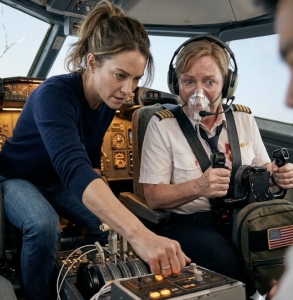
Sarah turned when Rebecca entered the cockpit.
Behind the oxygen mask, the captain’s face had gone gray, and David was trying to use the radio with one hand while the other hovered over a panel he could no longer read clearly.
“Who are you?” Sarah asked.
“Colonel Rebecca Thornton, retired. Call sign Viper. Fifteen years fighter aviation,” Rebecca said.
Her eyes moved across the instruments, the warnings, and David’s unfocused stare.
“Your first officer is concussed, your hydraulics are failing, and you are spending strength on everything except keeping this aircraft alive.”
Sarah did not argue.
Two hundred people were seated behind her, and the Boeing no longer responded in a predictable way.
“Can you work radios?”
Rebecca took the jump seat and reached for the communication controls.
They were not the switches of a fighter cockpit, but emergencies reduce different machines to the same questions: what still works, what is failing, who can see what the crew cannot, and how much time remains before the next change.
The yoke kicked hard enough to make Sarah gasp.
Rebecca leaned forward.
“You fly,” she said. “I’ll carry the chaos.”
She keyed the radio and called Denver Center.
“Denver Center, United 2847 has severe structural damage, injured flight crew, and limited control authority. This is Viper coordinating from the cockpit. We need immediate emergency routing, military escort if available, and crash crews staged for a rough landing.”
The controller answered with disciplined speed.
Other traffic was moved away from their path, emergency coordination began, and two F-35s operating in a nearby training range were redirected toward the airliner.
Rebecca kept her transmissions short so Sarah would not have to sort through unnecessary words.
She repeated headings, confirmed the damaged aircraft’s limited response, and asked the controller to avoid instructions requiring sharp turns.
Three minutes later, two gray fighter aircraft appeared beyond the cracked windshield.
One held position off the left side of the Boeing while the second remained farther back, where its pilot could inspect the tail.
“United 2847, Raptor Flight has you visual,” a new voice said.
Rebecca pressed the transmit switch.
“Raptor Flight, this is Viper. Move to visual assessment. I need eyes on our tail, stabilizers, and any fluid loss. Keep your calls clean. The captain is injured and still flying.”
The frequency became silent.
Sarah glanced toward Rebecca as far as the harness allowed.
“What did you just say?”
Before Rebecca could answer, the lead fighter pilot returned to the radio.
His voice had changed.
The formal distance of an escort pilot speaking to an unknown civilian aircraft had disappeared, replaced by the careful respect of someone addressing a person whose lessons had once been treated as survival instructions.
“Viper, ma’am,” he said. “Raptor One. I trained on your damaged-aircraft recovery lectures.”
David’s hand stopped above the panel.
Jennifer, standing in the cockpit doorway, looked from Rebecca to the fighter outside.
Raptor One continued.
“They told us the woman behind those tapes was retired. They never said we’d hear you on an airliner frequency.”
Rebecca’s expression did not move.
“Save it for the ground,” she replied. “Tell me what is still attached.”
That sentence restored the cockpit to its immediate problem.
Raptor One moved lower along the airliner’s left side, while Raptor Two shifted behind the Boeing for a wider look at the tail.
The fighters were not there to take command of the aircraft, and they could not repair the structure in the air.
Their value was vision.
Sarah could feel the jet moving, Rebecca could read what the instruments still reported, and the fighter pilots could see damage hidden from everyone inside.
Raptor Two reported visible deformation near the tail and an uneven stabilizer position.
A faint trail behind the aircraft might have been hydraulic fluid.
Rebecca repeated the report in plain language and asked the fighters to call every change, no matter how small.
David attempted to respond to a warning but lost his place on the panel.
His hand slipped from the radio into his lap.
Sarah saw it and, for the first time, the control she had forced into her face began to break.
Rebecca caught her gaze.
“Stay with the horizon,” she said. “You are still the captain. Fly what you have.”
Sarah nodded once.
She did not need a speech about courage.
She needed one task she could still own.
Raptor One moved closer to the damaged side and watched the stabilizer through another slow oscillation.
“Viper, we have a change,” he said. “The left side is no longer holding the same angle.”
Rebecca asked for the rate of movement and whether the change matched the aircraft’s yaw.
The answer came after the fighter dropped back for a wider view.
“The tail is opening farther every time she yaws.”
Rebecca looked at the instruments, then at Sarah’s hands.
A sharp correction could increase the load.
Doing nothing would allow the aircraft to continue drifting off its path.
The only usable option was to reduce the swings gradually and protect the damaged tail from another violent movement.
Rebecca asked Denver Center for the longest, straightest approach available and confirmed that crash crews were positioned.
She told the fighters to remain where Sarah could see them without chasing their formation.
Then she broke the problem into small instructions.
No sudden turns.
No unnecessary control input.
Let the aircraft settle before asking for the next change.
Sarah adjusted by degrees rather than force.
The Boeing continued to resist, but the yaw narrowed enough for Raptor Two to report that the damaged section was no longer opening as quickly.
That was not safety.
It was time.
In the cabin, Jennifer returned long enough to check the front rows and tell the other attendants what the cockpit needed.
Passengers were secured, loose objects were pushed away from the aisle, and every person capable of following directions was told to stay braced and listen.
The mother near the front finally reached her child’s hand across the narrow space between their seats.
Neither of them stopped crying, but the child stopped calling out.
The businessman beside 23C stared at Rebecca’s closed paperback as if it belonged to someone who had disappeared.
The college student at the window could see one of the F-35s holding position outside and kept both hands locked around the armrests.
In the cockpit, Denver Center cleared the damaged airliner toward the approach.
Sarah’s breathing had become shallow, and the effort required to hold the yoke was visible in her forearms.
Rebecca worked the radio and watched for the moment when the captain’s strength might fail completely.
David remained conscious but could no longer manage the workload safely.
Rebecca did not remove him from the cockpit or pretend she could become an airline captain in the middle of the emergency.
She gave Sarah information, took away distractions, and used the fighters as external eyes.
That distinction mattered.
The landing still belonged to the woman in the left seat.
As the ground drew closer, Raptor One called the tail condition after every noticeable movement.
Raptor Two monitored the opposite side and confirmed that the damage had not spread to a new area.
Rebecca relayed only what Sarah needed.
The cabin crew gave brace commands.
The noise of the damaged fuselage deepened as the air grew denser.
For a moment, Sarah’s hands began to overcorrect after another roll.
Rebecca placed her voice between the captain and the alarms.
“Small input,” she said. “Let it answer.”
Sarah eased the pressure.
The airplane responded slowly, then settled closer to the line of approach.
Raptor One’s next call was quiet.
“That’s it, Captain. Hold what you have.”
Sarah kept her eyes forward.
The runway came into view through the cracked windshield, bordered by emergency vehicles waiting at a safe distance.
Rebecca confirmed the wind information and then stopped talking for several seconds.
Too many words could become another alarm.
The Boeing descended unevenly.
One wing dipped, Sarah corrected, and the tail shuddered hard enough to make the cockpit door frame vibrate beneath Jennifer’s hand.
Raptor Two warned that the damaged section had moved again.
Rebecca asked for no additional detail.
They were too low for analysis that could not change the plan.
“Keep it straight,” she told Sarah.
The main landing gear reached the runway with a violent impact.
The aircraft bounced once, came down again, and pulled toward one side.
Sarah held the centerline with the limited control that remained while Rebecca transmitted their condition and warned the emergency crews to wait until the aircraft stopped moving.
Inside the cabin, masks swung, luggage shifted, and passengers remained folded into their brace positions.
The Boeing continued along the runway longer than anyone wanted.
Then its speed began to fall.
When the aircraft finally stopped, no one in the cockpit celebrated.
Sarah kept both hands on the controls until emergency crews confirmed the airplane was secure.
Jennifer waited for the evacuation command rather than allowing panic to turn the aisle into another danger.
Rebecca stayed on the radio long enough to coordinate the immediate handoff, then moved back so the working crew could manage the cabin.
Only after the doors were ready and the first passengers began moving did Sarah release the yoke.
Her hands shook when they were no longer required to be still.
David received attention for the injury above his eye and the symptoms Rebecca had noticed.
Sarah was helped from the cockpit because the pain in her ribs and the exhaustion of holding the damaged aircraft had finally caught up with her.
Rebecca stood near the cockpit doorway in the same jeans and navy sweater she had worn in 23C.
There was no uniform, no ceremony, and no need for one.
Raptor Flight remained on the frequency until ground control confirmed the airliner had stopped and emergency teams had reached it.
Before departing, Raptor One asked permission for one final transmission.
Rebecca keyed the radio.
“Go ahead.”
“Ma’am,” he said, “the lesson worked.”
For the first time since leaving her seat, Rebecca looked away from the instruments and out through the damaged windshield.
“The captain worked,” she answered. “Remember that.”
Sarah heard her.
So did Denver Center, the fighter pilots, and everyone still monitoring the frequency.
The legend they had recognized had not taken the controls or claimed the landing.
She had done something harder to see.
She had made the cockpit smaller than the crisis, given an injured captain room to keep flying, and turned two fighter jets, one radio, and a few remaining systems into a single coordinated crew.
Hours earlier, Rebecca Thornton had boarded as an anonymous passenger in 23C.
By the time the damaged Boeing stopped on the runway, the people around her understood why the call sign Viper had changed the voices of trained fighter pilots.
They had not answered a celebrity.
They had answered the instructor whose calm had once taught them what to do when an aircraft was wounded, the checklist ended, and survival depended on the next clean decision.